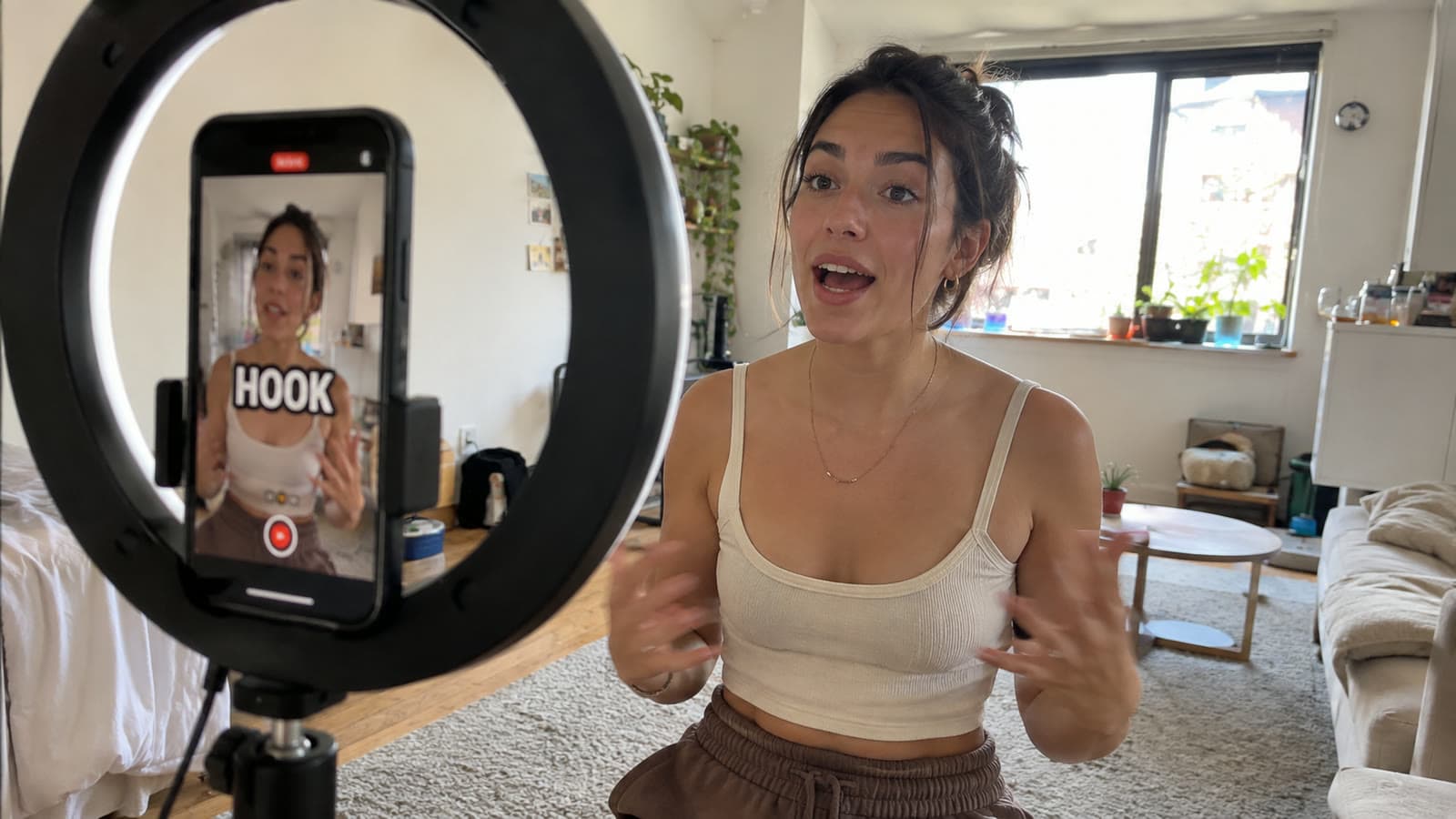
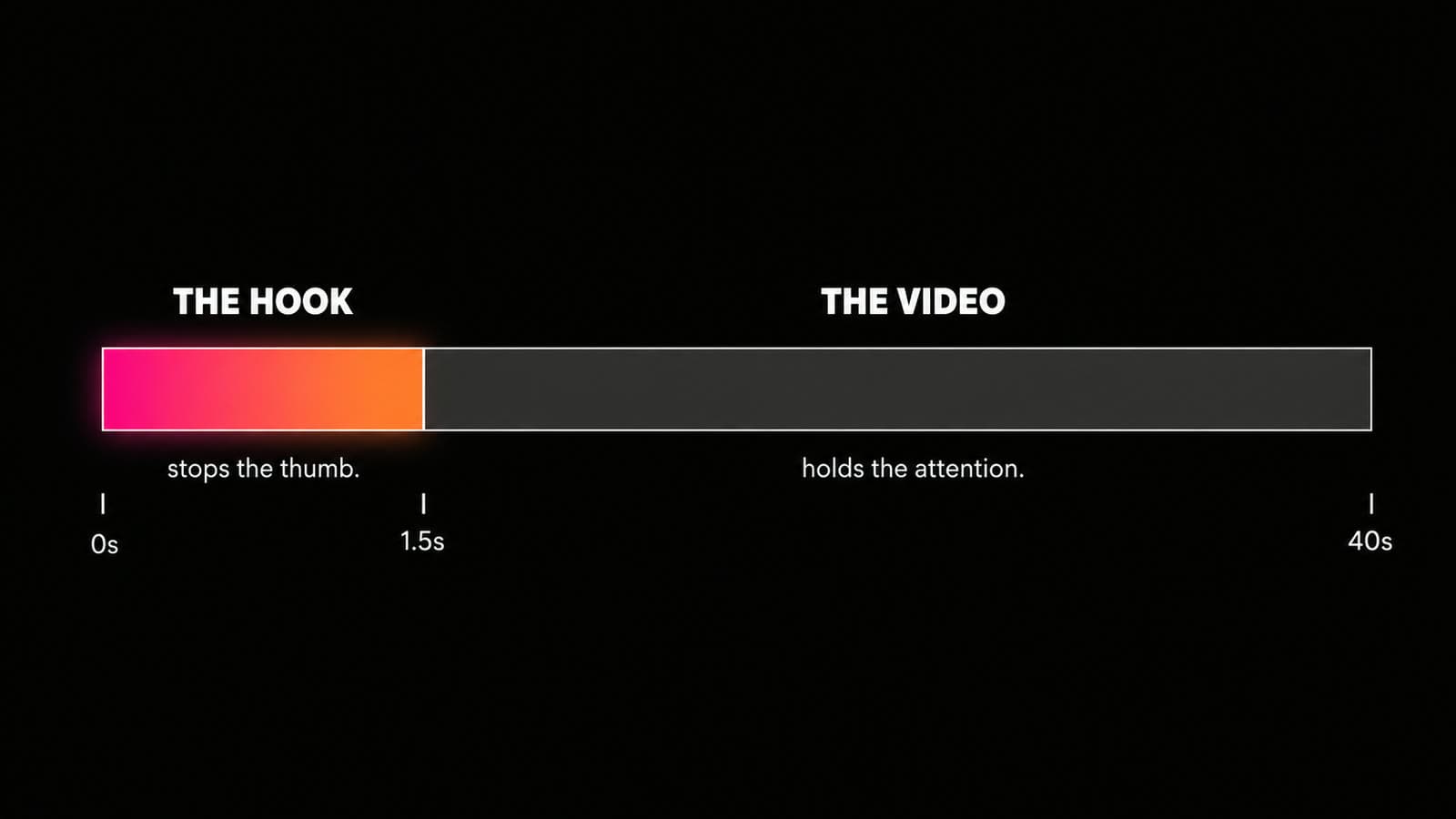
Every UGC video is two products stapled together. The hook is a 1.5 second product: its only job is to stop a thumb. The video is a 15 to 40 second product: its only job is to hold the attention the hook borrowed. Creators grade themselves on the video. The algorithm grades them on the hook.
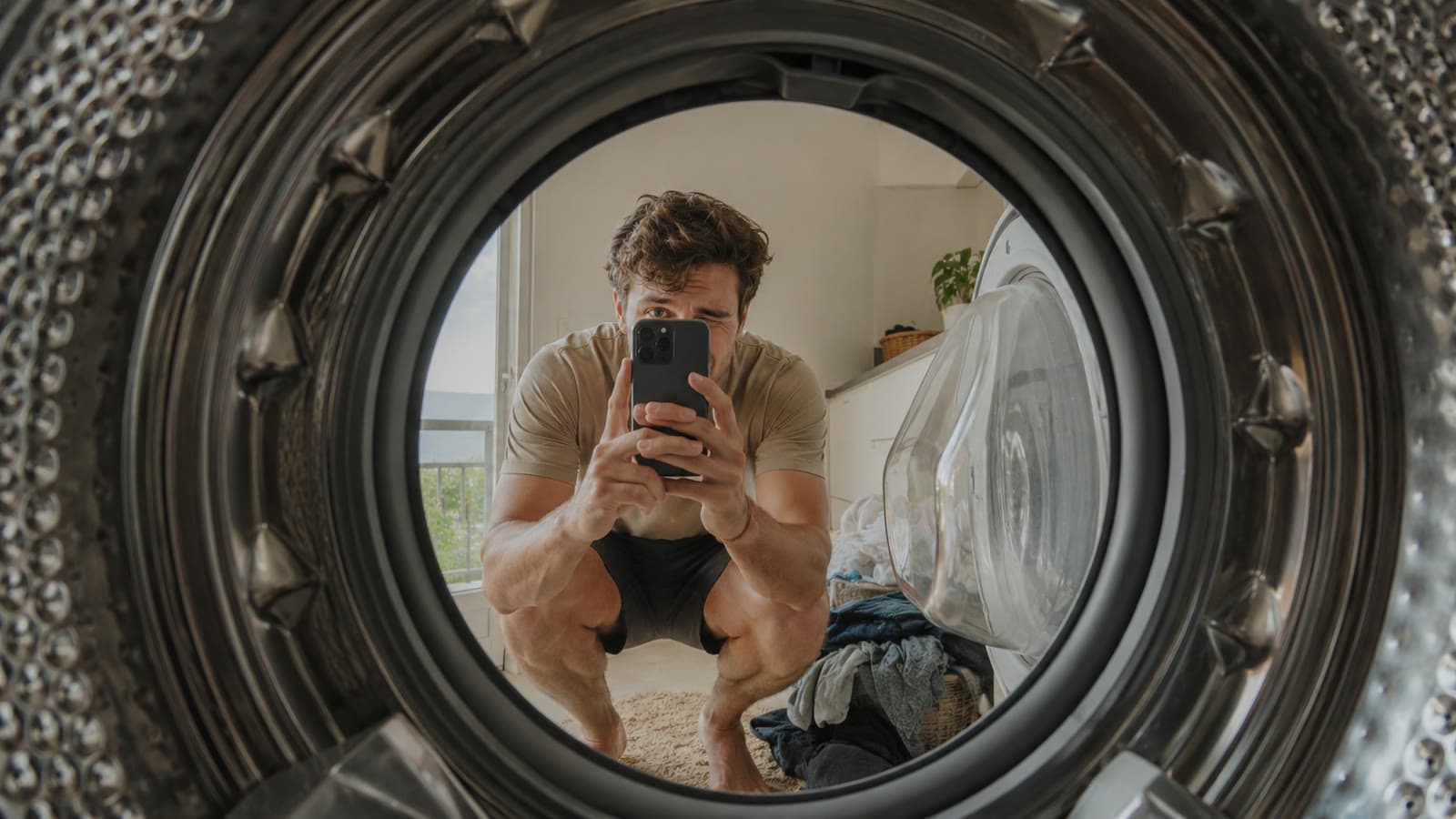
Three clips crossed my feed this week, and together they cover the whole problem. A US creator listing four mistakes (no movement in the first second, no on-screen text, no curiosity, no reason to stay) while demonstrating every fix: outfit changes every four seconds, hands never still, captions one floating word at a time. A French creator handing out five fill-in-the-blank hooks and one theory: a hook opens a gap, the video fills it. And a filmmaker, cj.filmed.it, who skips theory entirely: his own stats in frame one, then a camera filming from inside a washing machine. Text hooks, formula hooks, visual hooks.
The five templates, in English, ready to steal
![The five fill-in-the-blank hook templates as numbered rows on black: if I had to start from zero, nobody's talking about this, I tested [strategy] for [duration], I stopped [action], and I don't think we talk enough about the fact that. The placeholders glow pink to orange, and each row carries its persona tag: the Phoenix, the Kanye, the Serena, the Drake.](/_next/image?url=%2Fblog%2Ffive-hooks.jpg&w=3840&q=75&dpl=dpl_36FiDZs1RyrkQvuToaX6y4N6CtT1)
Templates work, but nobody remembers “curiosity gap opener type 3B.” Name a hook after a persona and it becomes a card you can play. You stop asking which hook to use and start asking who you are being for the first two seconds.
The deck: name your hooks like rappers
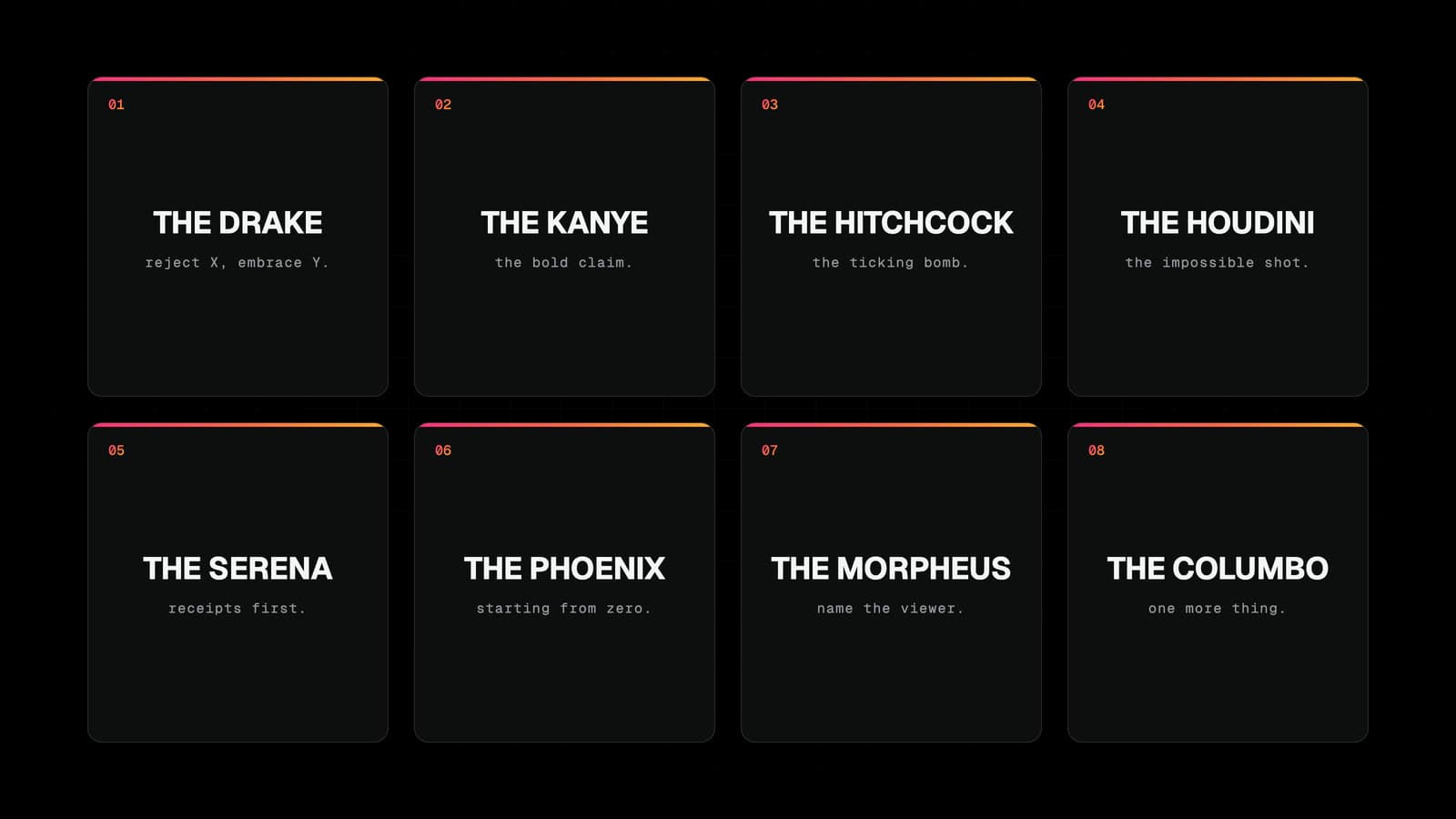
The Drake rejects the obvious thing, embraces the better thing: template 04, “I stopped [action],” in meme form, frame one boring, frame two yours. The Kanye is the bold claim that demands rebuttal (“miniature FX will replace 80% of Hollywood previz”): people argue, arguing is distribution. The Hitchcock plants a bomb under the table: “there's one mistake in this video, it cost me 2 million views, see if you catch it.”
The Houdini is the impossible visual, the shot whose first thought is “wait, how.” It needs no words at all, and for AI video it is home turf: the impossible camera move is the one thing AI does cheaper than a film crew.
The Serena shows receipts before the serve: your own analytics in frame one, template 03 said out loud. The Phoenix is template 01, starting from zero: the viewer doesn't want your history, they want your shortcut. The Morpheus names the viewer and offers a fork: “posting daily and stuck under 1K views? You have two options.” The Columbo turns at the door: payoff at 80%, then one more loop that only the next video closes.
Run it like this: one persona per video, hook written before you generate a single frame, checked against the US creator's four mistakes. Does something move in the first second, is there on-screen text, is there a gap, is there a reason to stay. Two of four, shoot it. Four of four, pin it. And say the persona name out loud in the video: “this is a Drake hook” is itself a hook, and authors of systems get quoted, stitched and stolen from.
The MJ principle: one glove for your AI model
Michael Jackson wore one glove. It cost nothing, meant nothing, and became one of the most recognizable objects of the 20th century. That is the entire brief for designing an AI UGC model, because the feed is full of beautiful nobody: symmetrical, poreless, forgettable. The fix is one deliberate flaw, loud enough to read at thumbnail size.
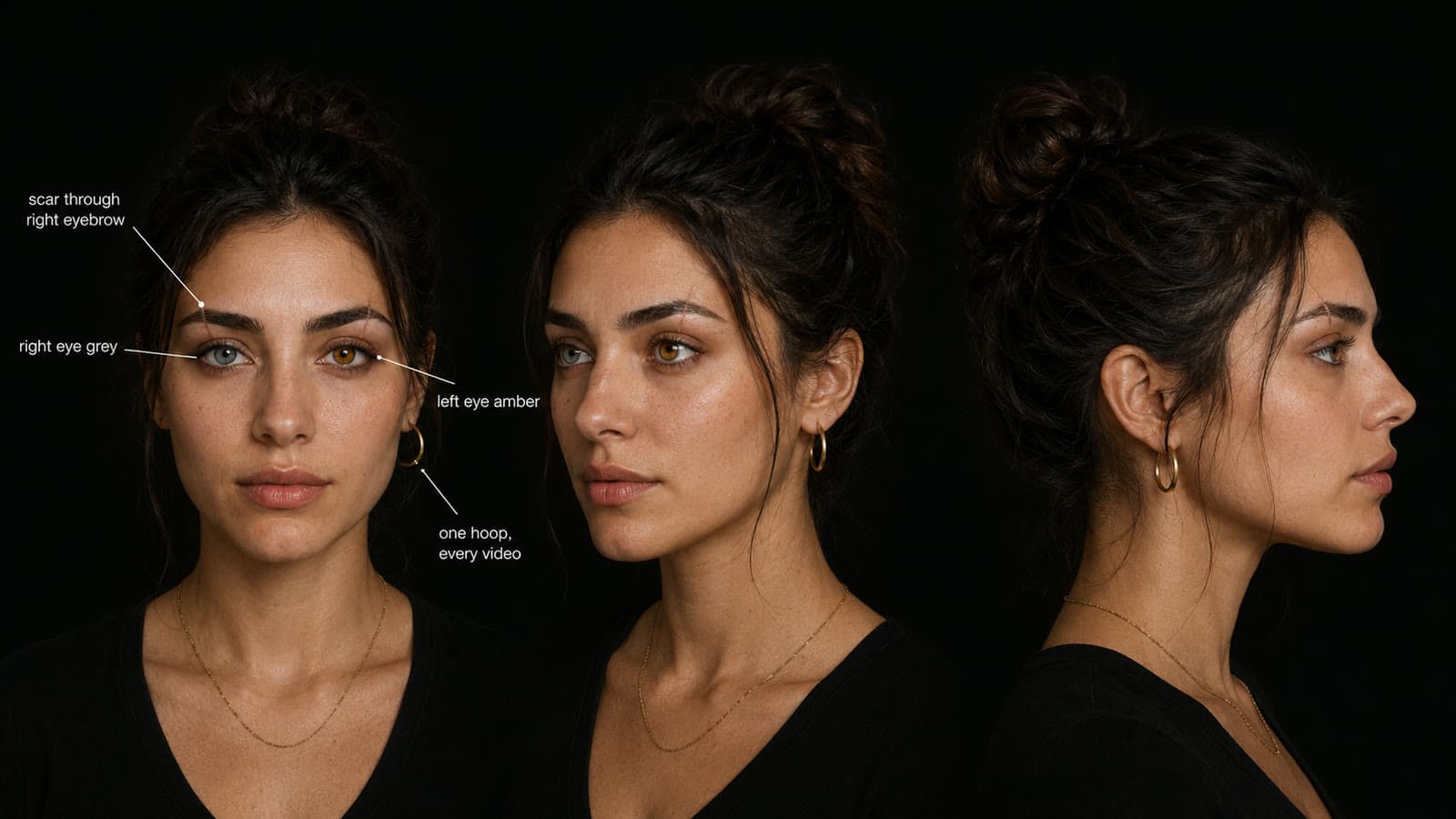
The quirk does four jobs at once. It is a pattern interrupt (the brain flags deviation, not perfection: a permanent Houdini). It is a consistency anchor: “left eye amber, right eye grey, scar through the right eyebrow” gives your QA one landmark to check instead of a vibe. It is recognition without a name: the girl with the two-colored eyes survives every stitch and repost that strips your handle. And it already works for humans: the French creator's oversized glasses, the US creator's red nails in every frame. They found it by instinct. You get to design it on purpose.
Three levels to choose your quirk from:
- 01Face-level, reads at thumbnail size: heterochromia, an eyebrow scar, a gap tooth, a white forelock.
- 02Object-level, the literal glove: signature glasses, one earring, always the same chipped nail colour.
- 03Behaviour-level, reads in motion: a fixed opening gesture, a verbal tic that opens every video.
Pick one primary, at most one secondary. It must survive every outfit change, be visible in frame one at 20% zoom, and fit in one sentence, because that sentence goes verbatim into every prompt. Give it lore you never explain: where the scar came from is a Hitchcock bomb you can let tick for fifty videos. Hooks are offense, the quirk is defense: hooks get the first video watched, the quirk gets the second one recognized. The follow button measures retention across videos, not within one.
What this means for @oldhollywoodfx
The Houdini is already @oldhollywoodfx's native format: every miniature-set video is an impossible visual wearing a behind-the-scenes costume, and the comment argument (practical or not?) is the gap doing its work. The missing layer is the glove: a recurring quirked character inside the sets, a tiny director with a scar who appears in every FX video, turning one-off bangers into a followable series.
The tornado through the Rialto is the Houdini. The crew in matching tees is already halfway to a glove.
The 7-day plan
- 01Day 1: write your quirk sentence. One trait, one line, locked.
- 02Day 2: character sheet, 10 angles, quirk visible in all 10. Kill any generation where it drifts.
- 03Days 3 to 5: three videos, one Houdini, one Kanye, one Serena. Same model, same quirk.
- 04Day 6: read comments. The hook people quote back is your house style.
- 05Day 7: run the Columbo, and gate the bonus: comment a number, the full deck lands in DMs.
One glove. One persona per video. Two layers, graded separately. That's the whole game.