A build-in-public post came past this week that is very good at what it does. Day 8 of scaling a new app to $25,000 a month in 30 days. One video went kinda viral. First $350 day, number 110 in the App Store, and the line that makes the whole thing travel: with a little bit of founder math we are basically on track to $10k/mo.
The app is not named in the post. That is deliberate, and it took about four minutes to work around: the replies mention it, the developer account lists it, and the store prints everything else for free. It is holy mode: quit & defeat lust, by Covenant Studios, LLC, who also publish prayer lock: christian focus, the app they scaled first and the one every number in the thread is implicitly borrowing credibility from.
So I did the thing this site does with a viral claim, which is read the primary source instead of the screenshot. Everything below came out of Apple’s own public endpoints and two browser tabs, on 25 August 2026. The founder numbers I cannot check, and I will say so each time one appears. The store numbers I can, and they tell a much better story than the post does.
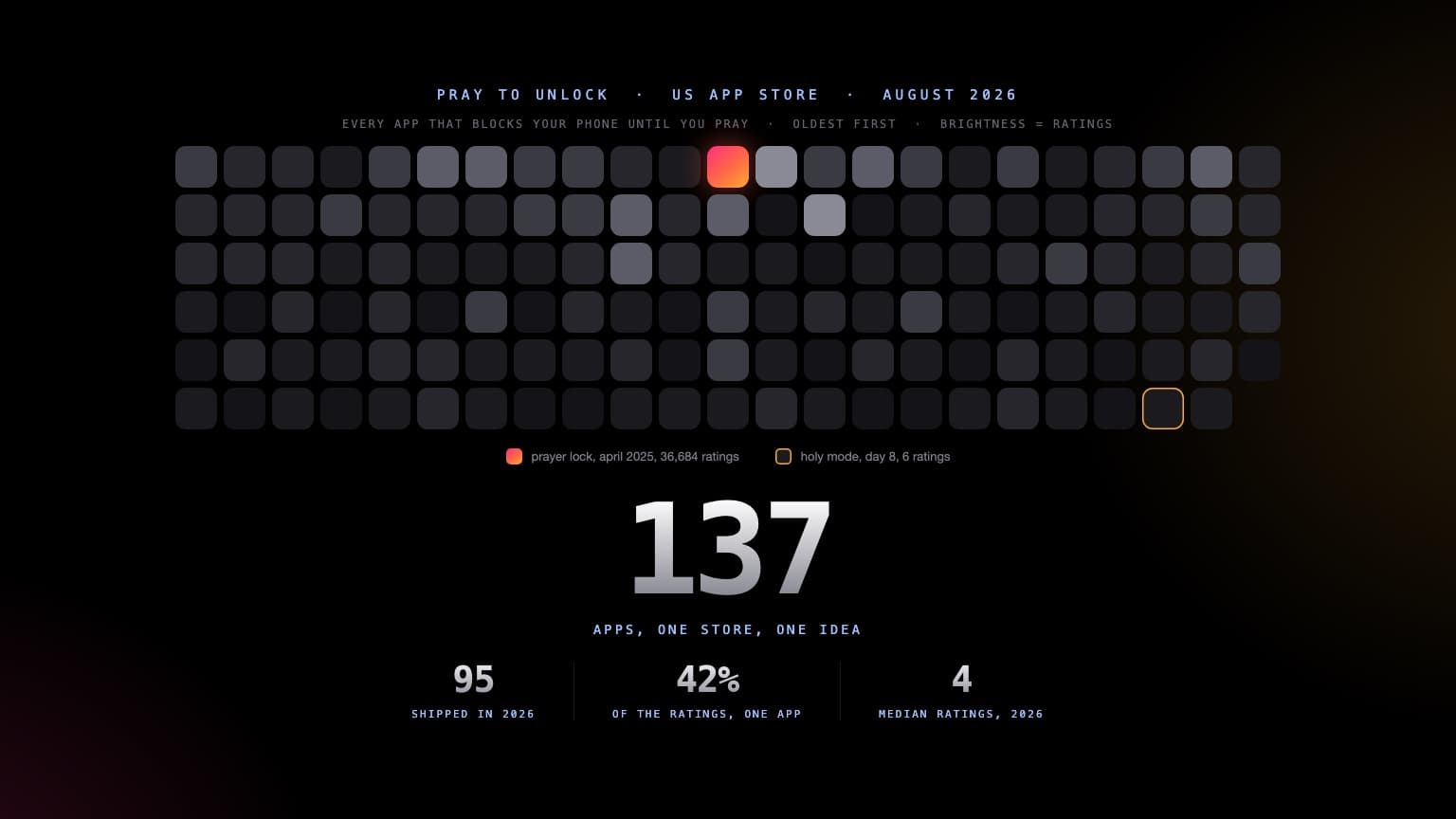
137
apps in the niche
block your phone until you pray
95
shipped in 2026
69% of the field is this year old
4
median ratings
for those 95 newcomers
42%
held by one app
share of every rating in the niche
What the store says, read live
Two listings, same publisher, same category, opened side by side. No dashboards, no screenshots of dashboards, just the page Apple serves to anyone.
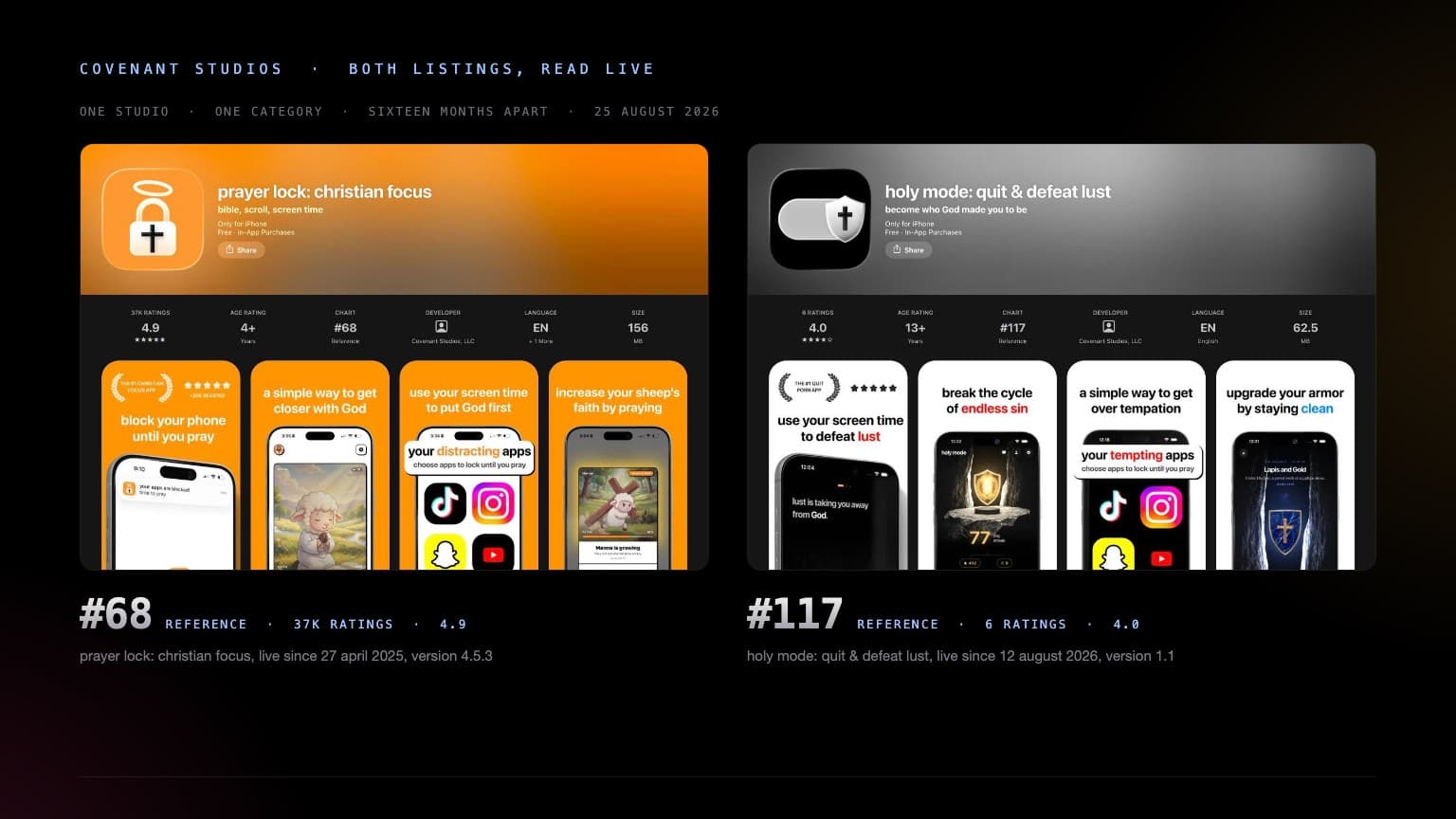
prayer lock went live on 27 April 2025, is on version 4.5.3 as of 19 August 2026, holds 36,684 ratings at 4.87, and sits at #68 in Reference. That is a real business. Nothing in this article argues otherwise.
holy mode went live on 12 August 2026, shipped version 1.1 two days later, holds 6 ratings at 4.0, and sits at #117 in Reference. The post said #110. Both are true, a week apart, which is the first useful thing to notice: a rank is a photograph, not a position. It moves on days you did nothing.
The developer page lists three apps, not the five that get repeated around these threads: prayer lock, holy mode, and Viewtrack App, their own creator-tracking tool. I went looking for the walk-to-unlock app people attribute to them and found StepTower: Walk to Scroll, published by someone else entirely. Worth knowing before you cite a portfolio.
The same slide, twice
Then I looked at the screenshots, which is where the actual playbook is hiding. An App Store screenshot set is the most expensive real estate a small app owns. It is the ad, the pitch and the paywall preview at once.
Slide three of four is the same slide on both listings. Same headline shape, same white caption pill, same second line, same four app icons in the same order.
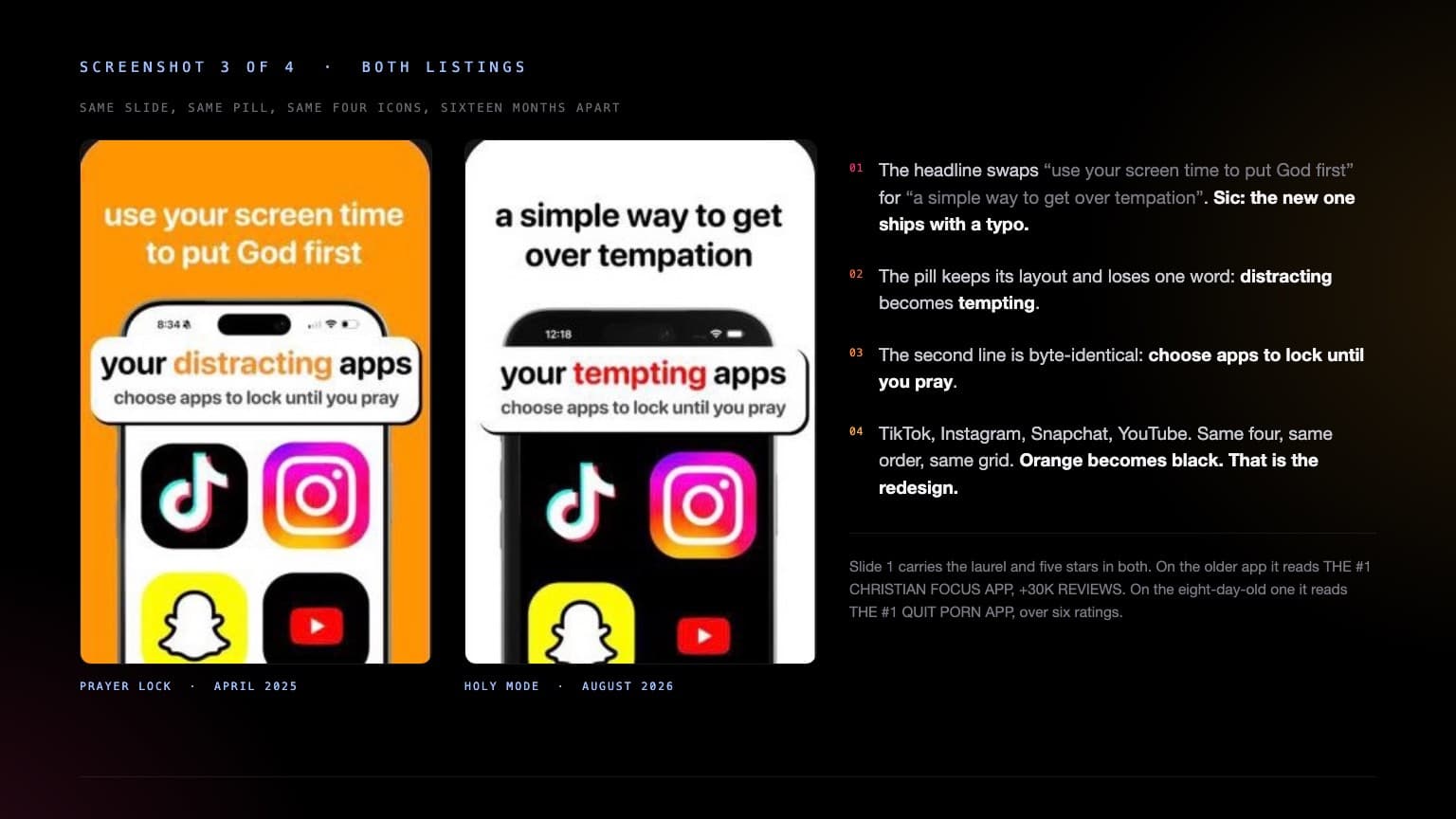
One word moved inside the pill: distracting became tempting. The line under it, choose apps to lock until you pray, did not change at all. Orange became black. That is the redesign.
The new headline also ships with a typo. It reads a simple way to get over tempation, missing its second p, on a slide Apple has been serving since the twelfth. And slide one carries the same laurel wreath and five stars in both listings: on prayer lock it says THE #1 CHRISTIAN FOCUS APP with +30K REVIEWS under it, which is defensible at 36,684 ratings. On holy mode it says THE #1 QUIT PORN APP, over six.
I am not scandalised by any of that, and neither should you be. It is the most honest description of the method available: the asset is the template, and the template ships before the polish. A typo that survives thirteen days is not sloppiness, it is a correct read of what actually gates growth. Nobody churned over a missing p.
Reference is not a category
Both apps chart in Reference, and the ranking screenshots are always Reference, so it is worth asking what Reference is. I pulled the live US top 100 free list and classified every row by what the app actually does, from its name and publisher.
US App Store · Reference · top 100 free · 25 august 2026
38 · including prayer lock at #68
Christian apps: bibles, devotionals, prayer, blockers
24
Everything else: dictionaries, Wikipedia, ancestry, guides
22
Scanners and collectible trackers: coins, cards, antiques
10
Translators
6
Muslim prayer and Quran apps
Forty-four of the hundred top free Reference apps in the United States are faith apps, thirty-eight of them Christian. Reference is three unrelated businesses sharing a door: scripture, scanners and translators. The classification is my judgement on names, so call it approximate at the edges, but not by much: you can run the same list in one curl and disagree with me row by row.
This matters because of how the ranking gets used. A screenshot saying #110 in Reference is doing rhetorical work that #110 among American Bible apps would not do. It is the same fact. It just sounds like the App Store rather than like a niche.
Then I counted the others
Here is the part that changed how I read the original post. I ran fifteen App Store searches around this exact mechanic, deduplicated by track id, and kept every app whose title pairs a faith word with a blocking word. Lock, block, focus, screen time, scroll, unlock, quit, mode, pause.
terms  = pray to unlock, christian app blocker, prayer screen time,
         bible app blocker, quit lust christian, christian focus,
         pray before you scroll, faith screen time, prayer lock,
         holy mode, scripture blocker, christian porn blocker,
         bible focus, pray unlock apps, christian screen time

428 unique apps returned
137 match faith word + blocking word in the title
 95 of those first shipped in 2026
One hundred and thirty-seven apps whose entire proposition is that your phone stays locked until you pray. Ninety-five of them shipped this year. Twenty-three have the words prayer lock in the title, and the 137 include Christian, Muslim and Sikh variants of the same mechanic. Search is a blunt instrument and the real number is higher, not lower, because anything that named itself cleverly enough to dodge my keywords is missing from the count.
And the idea did not start with the app in the thread. Sorted by launch date, the lineage is unambiguous:
the shape, in order of arrival
| App | Live since | Ratings today |
|---|---|---|
| QUITTR: break free now | July 2024 | 33,288 |
| Pray Screen Time: Bible Focus | November 2024 | 9,589 |
| Unchaind: Overcome Lust | February 2025 | 36,491 |
| prayer lock: christian focus | April 2025 | 36,684 |
| Bible Mode: Reduce Screen Time | May 2025 | 11,931 |
| BibleScroll: Christian Focus | February 2026 | 3,400 |
| Faith Mode: Christian Focus | April 2026 | 940 |
| holy mode: quit & defeat lust | August 2026 | 6 |
Pray Screen Time shipped the pray-to-unlock mechanic five months before prayer lock did, and has a quarter of the ratings today. A reply under the original post calls the new launch just the Quittr playbook, and Quittr is right there at the top of the table, from July 2024. So the honest framing of this whole operation is not we found a niche. It is we were fourth to a shape and we won it anyway, which is a far more interesting claim, and the one the numbers actually support.
Half of them have fewer than ten ratings
Ratings are a rough proxy for users and a very good proxy for whether anything is happening at all. Across all 137:
ratings per app · 137 apps · us store
22 apps · nobody arrived
Zero ratings
46 apps · friends and family
One to nine
41 apps
Ten to ninety-nine
18 apps
One hundred to 999
7 apps
One thousand to 9,999
3 apps · prayer lock, Bible Mode, Scroll The Bible
Ten thousand and up
Sixty-eight of 137 have fewer than ten ratings. One hundred and nine have fewer than a hundred. prayer lock alone holds 41.7% of every rating in the niche, and the top five hold 81.8%. Of the ninety-five apps that launched in 2026, exactly one has cleared a thousand ratings.
That is the shape of every distribution-limited market, and it is the answer to the question the original post never asks. Ninety-five teams had this idea this year. Ninety-four of them are invisible. The idea was never the scarce thing.
The playbook, in full, because it is not a secret
None of this is hidden. Both founders describe it constantly, and the artefacts corroborate it. Written out plainly:
the loop · five steps · none of them the app
01
Clone a ranked shape
not a new mechanic, a listing that already charts
02
Ship in a fortnight
v1.0 on 12 August, v1.1 on the 14th
03
Hard paywall
Superwall, everyone hits it, nothing free to keep
04
Three UGC creators
TikTok, Instagram, YouTube, volume over polish
05
Boost the winner
the video that pops becomes the paid creative
Clone a ranked shape. The screenshot comparison above is this step, photographed. They did not design a new onboarding, they recoloured one that converts and pointed it at an adjacent pain. Lust instead of distraction, same four icons, same promise.
Ship in a fortnight. Apple’s own dates: 1.0 on 12 August, 1.1 on 14 August. Nothing about that build is precious, including the typo. The clock starts at listing, not at polish.
Hard paywall. This is the one worth stealing and the one most people mangle. Every feature sits behind the wall, so the funnel has one gate and one number. Two figures circulate from their Superwall screenshots and they are not the same figure: paywall rate around 91 to 94% means almost everybody who opens the app sees the wall, which is what a hard paywall is for and is not an achievement. The one about money is the other one: initial conversion around 4%. Both come from their screenshots. I have no way to verify either.
Three UGC creators. Hired on day one, posting daily across three platforms. The stated purpose is not reach, it is sample size: you cannot pick a winning creative until forty of them have run.
Boost the winner. The clip that breaks out becomes a Spark ad on TikTok and a Meta creative, aimed at a web funnel where a subscription escapes Apple’s commission. Then the chart position becomes the next build-in-public post, which recruits the next creators. The loop closes on itself, and the audience for the posts is not the customer, it is the supply.
Notice what is not in the loop anywhere. Not the app. Not the idea. Not the code. Five steps, and four of them are distribution.
Now the founder math
The claim is $349 in a day, 369 new users, and basically on track to $10k/mo. Take the numbers at face value for a moment and just do the arithmetic honestly.
$349 × 30 = $10,470. So the founder math is arithmetically fine, and it is also answering a question nobody asked, because the stated target is $25,000 a month inside 30 days. That needs $833 a day, which is 2.4 times day eight, starting from a day that a viral video paid for and with twenty-two days left.
Then divide the other way. $349 across 369 new users is $0.95 of revenue per new user. A reply under their own post puts acquisition at around $1 per new user with a hard paywall. If both of those are roughly right, day eight grossed approximately what day eight cost.
$10k
thirty of those days
$10,470 exactly, and the founder math checks out
$25k
the stated goal
$25,000, which needs $833 a day, not $349
$0.95
revenue per user
against a reported ~$1 to acquire one
22
days left
to find 2.4x, without another viral video
So the interesting question is not whether $349 is real. It probably is. The question is what it is a receipt for, and on day eight of a paid launch the answer is: a loan, priced at roughly one dollar per user, repayable in month two. All the profit lives in renewals of subscriptions sold to people who installed an app to stop an impulse, which is not a category famous for month-two retention. That is not a criticism of the business, it is a description of it. They know this better than I do, which is exactly why they hire the creators before they finish the app.
And the honest read of the ranking claim is the same shape. #110, then #117 a week later, in a category where 38 of the top 100 are Christian apps and a direct competitor named BibleScroll: Christian Focus, live since February, sits at #32, well above prayer lock itself. The clone that copied them outranks them today. The chart is not a moat, it is weather.
Check any of this yourself, in four commands
This is the part I actually want you to take. Apple runs public, unauthenticated endpoints that answer most questions people pay intelligence tools for. No key, no account, no scraper.
# every app under one publisher, live
curl -s "https://itunes.apple.com/lookup?id=1800107690\
&entity=software&limit=200&country=us" \
  | jq -r '.results[].trackName'

# one app: launch date, last ship, ratings, seller
curl -s "https://itunes.apple.com/lookup?id=6795748539&country=us" \
  | jq '.results[0] | {releaseDate, currentVersionReleaseDate,
        version, userRatingCount, averageUserRating, sellerUrl}'

# the live US Reference free chart, 100 rows
curl -s "https://itunes.apple.com/us/rss/topfreeapplications/\
limit=200/genre=6006/json" \
  | jq -r '.feed.entry[] | ."im:name".label'

# census a niche: search, dedupe on trackId, filter on title
curl -s "https://itunes.apple.com/search?term=pray+to+unlock\
&country=us&entity=software&limit=50" \
  | jq -r '.results[] | "\(.releaseDate[0:10])  \(.trackName)"'
Genre 6006 is Reference. Swap it for whichever category you are being sold a ranking screenshot from. The publisher id comes back inside any single-app lookup as artistId, which is how you turn one App Store link into a whole portfolio in one request.
That leaves the ads, which is the one thing I could not get. The Meta Ad Library is genuinely the right tool and the URL is trivial to build: pick the country, set q=prayer+lock or the app name, filter to active. I ran it twice while writing this and the result grid never resolved past its loading skeletons, so I have no ad receipt to show you and I am not going to describe creatives I did not see. Run it yourself; it works more often than it did for me this afternoon.
https://www.facebook.com/ads/library/
  ?active_status=active
  &ad_type=all
  &country=US
  &q=prayer%20lock
  &search_type=keyword_unordered
The other half of their spend is not in any library, because it does not look like advertising. It is three creators posting organic-shaped video every day, of which only the winners are ever boosted. If you want to see that inventory, the place to look is TikTok search for the app name, sorted by views, and the tell is a hook filmed on a phone in a bedroom with the app demoed for four seconds in the middle.
What I take from it
Three things, and none of them are cynical.
The idea is worth nothing and everybody now knows it. Ninety-five people shipped this exact app in 2026 and their median has four ratings. If you are still choosing between ideas, you are working on the part that has no scarcity left in it. The founders in this story are not confused about that for a second, and the thread reads differently once you notice they are documenting a distribution operation and calling it an app launch.
Build the audit before the ambition. It took under an hour to establish launch dates, version cadence, live chart positions, the full publisher catalogue, a 137-app census and a rating distribution, for free, without asking anyone. If you are entering a niche because a screenshot impressed you, spend that hour first. The screenshot is one day of one funnel. The census is the market.
Publish the number that can be checked. Every figure that made this article possible was one Apple prints itself. Every figure I had to hedge came from a dashboard only one person can see. That is a lesson about my own posts more than theirs: when the checkable number and the impressive number are different numbers, the audience eventually works out which one you chose, and the cost of that arrives later than the benefit does.
For the record, I hope they hit the twenty-five. Doing it would take $833 a day by mid-September, from a standing start, on the strength of creators they have to keep feeding. Whether they make it or not, the receipts will be public in a fortnight, and that is more than most of this genre can say.