Eighty-seven seconds of TikTok arrived in my feed claiming to describe an AI clipping system “so good it is scientifically impossible to fail”, which is the kind of sentence that makes me either close the app or open a terminal. I opened a terminal. I pulled the video apart frame by frame, read every burned-in caption to reconstruct the script, and read every screen he points at.
The claim in the first two seconds is nonsense and he knows it. The argument underneath it is the best one I have heard about short-form in a year, and it is not really about video at all. It is about the fact that the expensive half of clipping a podcast has already been free for years, and almost nobody has noticed which half is the other one.
The move that makes the whole argument work
Twenty seconds in he stops talking about AI and points his phone at remotion.dev, which is a library for making video in React. Captions, silence removal, reframing, rendering: all of it as code, all of it free, all of it solved, none of it new.
That is the trap closing. If the mechanical act of cutting a video is free and has been for years, then the reason your clips do not work is not the cutting. Which leaves the only question that was ever hard:
Out of a two hour episode, which forty seconds were worth cutting?
His phrasing is that the model knows how to cut a video but not which moment needs to be a clip, because it has no context and no content intelligence. Every automatic clipping tool on the market is selling you the free half with a subscription attached to it.
The pipeline is five moves and no new software
five moves · no new software
01
Scrape
every published clip, with its numbers
02
Match
clip back to its source moment
03
Store
one row per clip, the Clip Brain
04
Decide
query before you cut
05
Cut
Remotion, in code, free
- 01Scrape two or three reference accounts in your niche for every short-form clip they have published, with views, likes, comments and dates. He names The Diary Of A CEO and Alex Hormozi, and uses Apify, though any scraper does the job.
- 02Scrape the long-form sources those clips were cut from: the full episodes, with transcripts and timestamps.
- 03Have Claude match the two. For every clip, find the exact passage in the source transcript it came from. This is the step that creates all of the value and it is one prompt.
- 04Store the result in Supabase. One row per clip, joined to its source moment and its outcome. He calls the result the Clip Brain.
- 05Query it before you cut. Same episode, different hooks, measured outcomes. Then let Remotion do the mechanical part for free.
The stack is deliberately boring, and he says so on screen: it runs on a real stack, no new software.
Apify      scrape short-form clips + long-form sources
Claude     match clip transcript -> source transcript
Supabase   one row per clip, joined to source and outcome
Notion     the ideas that survive the query
Remotion   the cut itself, in code, free
GitHub     the skills
Nothing on that list is a moat. I already pay for four of the six. That is the point of the design, and it is why the interesting part is not the tools.
Step three is the entire product
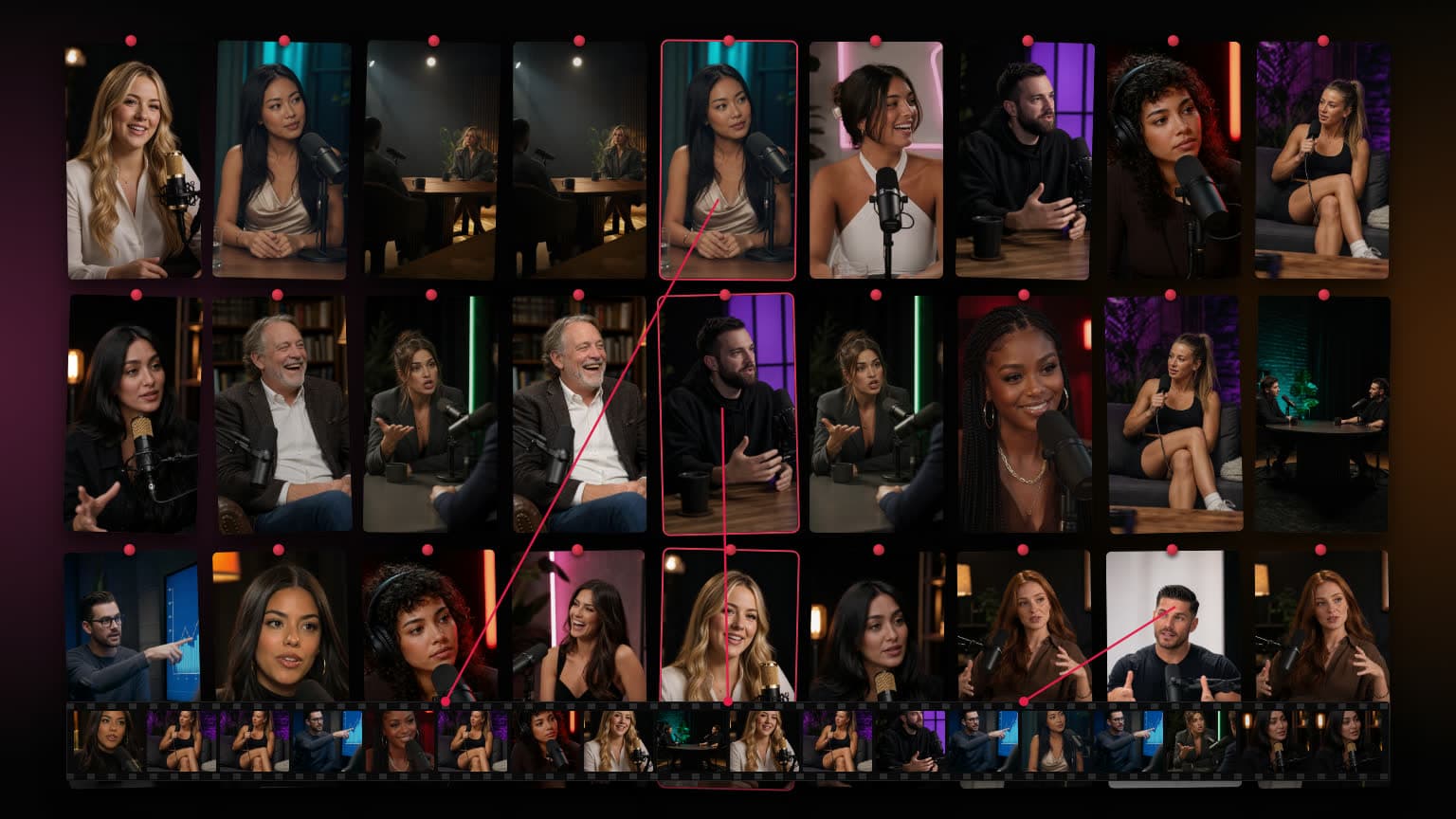
It is the image at the top of this page: thirty clips pinned on a wall, the source footage in a strip underneath, and a thread drawn from each clip down to the exact frame it was taken from. Everything the system knows comes from being able to draw those threads.
A scrape of eleven thousand clips is a spreadsheet. A scrape of eleven thousand clips joined back to the moment each one was cut from is something nobody else has, because it is the only artefact that holds both halves of the experiment: the raw material, and what happened when a professional editor chose one part of it over the rest.
Once that join exists you can ask a question no clipping tool can answer. Not “what makes a good hook”, which returns a listicle, but: here are two clips cut from the same forty minutes by the same team for the same audience, and one of them did twenty times the numbers. Everything except the cut is held constant. The cut is the only variable left.
Same episode, two cuts
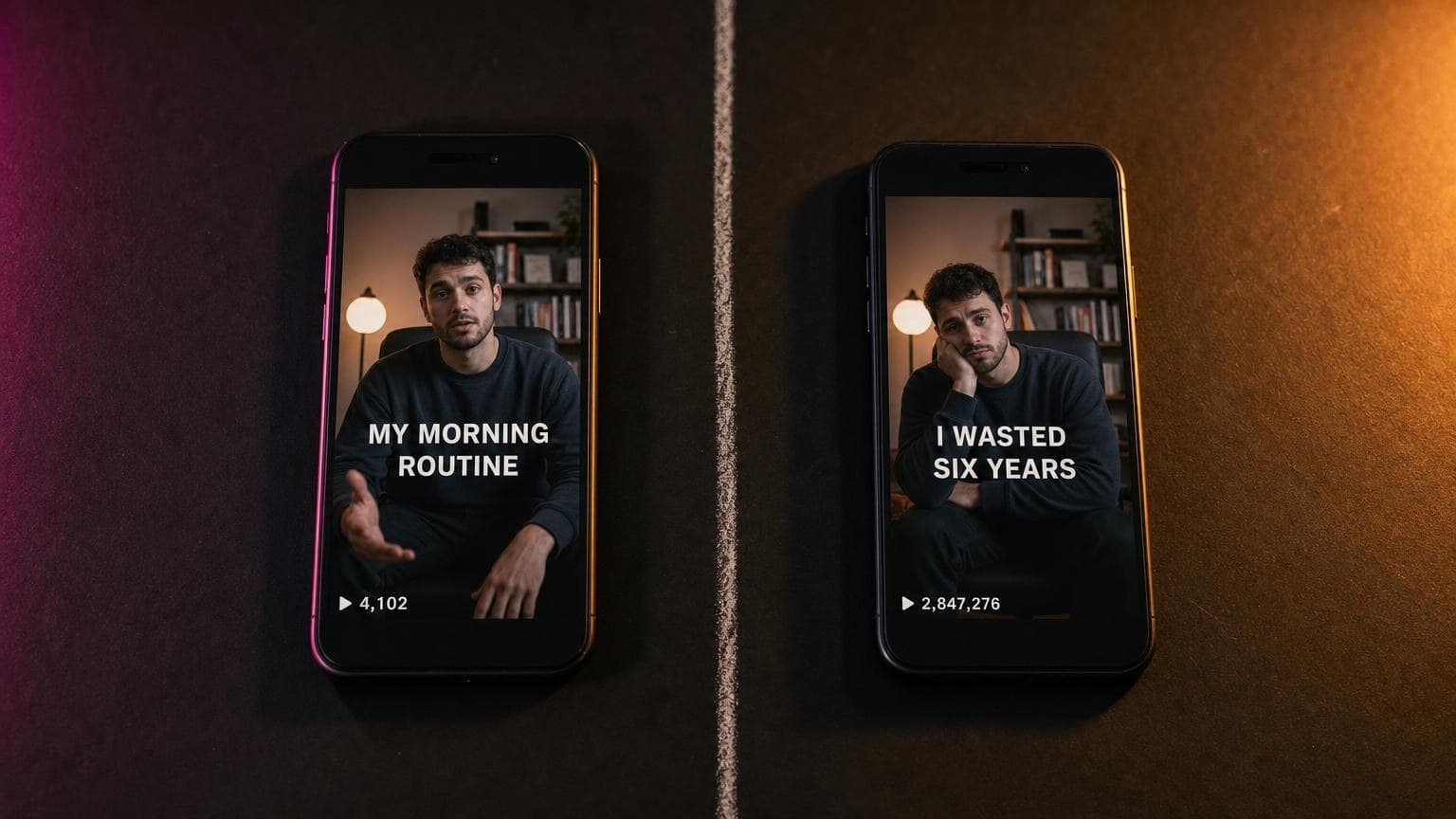
This is the demo at the centre of the video, and it is the right demo. He puts two clips from one episode side by side and shows the multiplier between them. The three figures on screen are 13.0x, 29.3x and 25.1x. His line over the top of it: this happens so consistently when you run it across thousands of clips.
His conclusion, and I think it is correct: the format is not a matter of taste. It is measurable, and everyone is guessing at something that has been sitting in public data the whole time.
same episode · same team · two cuts
4,102 views
"My morning routine"
2,847,276 views · 694x
"I wasted six years"
Where it beats OpusClip, and where the argument leaks
The honest comparison is narrower than the video implies, because the two things are not competing on the same axis at all.
                          automatic clipper      this
cut, caption, reframe     yes                    yes, via Remotion
which moment to cut       generic heuristics     matched to real outcomes
evidence for a hook       none                   same-episode comparisons
improves with use         no                     yes, the table grows
cost                      subscription           scraper + API calls
what you own at the end   nothing                the table
That last row is the argument. Everyone using the same tool gets the same output, so the tool cannot be an advantage to anyone; the table can only exist for whoever built it. He is right that this is a moat and right that it is the only one available here.
Three places it leaks, none of which the video mentions.
It is a survivor's dataset. Scraping published clips gives you what a good team decided to publish. The moments they cut and killed are not in the data, so the system learns what wins among things already judged worth posting, which is a much smaller claim than knowing what wins.
Distribution is inside the measurement. Two clips from one episode are not two arms of a clean trial. They went out on different days, at different times, into a feed that had already decided how it felt about the last one. A 29x gap is real, but the cut is not the only thing that produced it, and nothing in the pipeline separates the two.
It learns the past of the largest accounts. A corpus of what already won is a very well-researched way to arrive at the median twelve months late. The same failure mode I wrote about with design reference libraries applies here without a single word changed: grounding every decision in what worked is how you reliably produce what worked.
None of that makes the system worse than the alternative. The alternative is guessing. It just means the output is a strong prior, not a verdict, and the video sells it as a verdict.
The moat is a table, and that is the transferable part
the moat, literally · one row per clip
| clip | cut from | outcome |
|---|---|---|
| "My morning routine" | the same forty minutes | 4,102 views |
| "I wasted six years" | the same forty minutes | 2,847,276 views |
| 11,598 more rows | each joined to its moment | each with its numbers |
Strip the video of its subject and the structure is one I keep running into this month, in design tools and now in video: a memo can tell a model what tends to work, and only a corpus can show it a specific alternative. Written advice about hooks is the memo. Eleven thousand matched clips is the corpus. You cannot get the second by writing a better prompt, which is exactly why it is worth building and exactly why nobody sells it to you.
If I run this, and I probably will, the only new part is the scraping. Claude Code, Supabase and Notion are already on this box, and the join step is an afternoon. The part I would change is the analysis: compare within an episode only, never across the whole corpus, because the moment you pool episodes you are measuring the subject and telling yourself you measured the cut.
The other system in the video is the video
Worth saying, because it is doing as much work as the pipeline. The eighty-seven seconds are built as carefully as the thing they describe, and six of the choices are stealable on their own.
- 01An opening claim big enough to be obviously false. Scientifically impossible to fail buys a reaction whether you believe it or not, and both reactions retain.
- 02Captions one word at a time, centred and large, so you cannot read ahead of the speech and the video is legible with the sound off.
- 03A handheld phone pointed at his own screen, with his finger physically on the thing he is describing. It is not a screen recording, which is why it reads as real.
- 04Every screen is a custom dark slide he built, THE CLIP MACHINE and THE CLIP BRAIN, never a raw screenshot of somebody else’s tool. The set decoration is the credibility.
- 05Structure as a reversal: prove the obvious problem is already solved for free, then the real problem is the only thing left standing and his answer looks inevitable rather than sold.
- 06An open loop instead of a link. Want the full system? has no instruction attached, so the answer is a comment, which is reach, which is a DM list.
The second one is the one I would adopt tomorrow. The last one is the one to be honest about: the video is a lead magnet, and a lead magnet is allowed to be a good argument at the same time.
What I actually take from it
The claim in the hook is false and the thesis under it is right. Cutting has been free for years and everyone is still paying for it. The scarce thing is knowing which forty seconds of two hours were worth anyone's attention, and the only honest way to know is to look at every case where somebody already answered that question and see what happened to them.
He built a table that answers it, called it a brain, and then told everyone how to build their own, which is a strange thing to do with a moat and a very good thing to do with an audience. The numbers are unverifiable. The method is not, and the method is the part you can steal.