

RecordLab
macOS 14+·SwiftUI·no accounts
Record raw. Decide later.
Nothing cinematic is baked into the capture. The screen, the camera and the cursor are recorded straight, and every zoom, crop, backdrop and tilt is a decision you make afterwards, non-destructively, and can take back.
- Freeno price, no plan
- Open sourcesoon
- Mac App Storesoon
Instead of Screen Studio
What RecordLab is
RecordLab captures the screen at 4K60 in HEVC with optional system audio, the camera and microphone alongside it, and a 60 Hz log of where the cursor was and when it was clicked. The cursor is hidden in the capture on purpose: it gets drawn back in the edit, at the right size, in the right place.
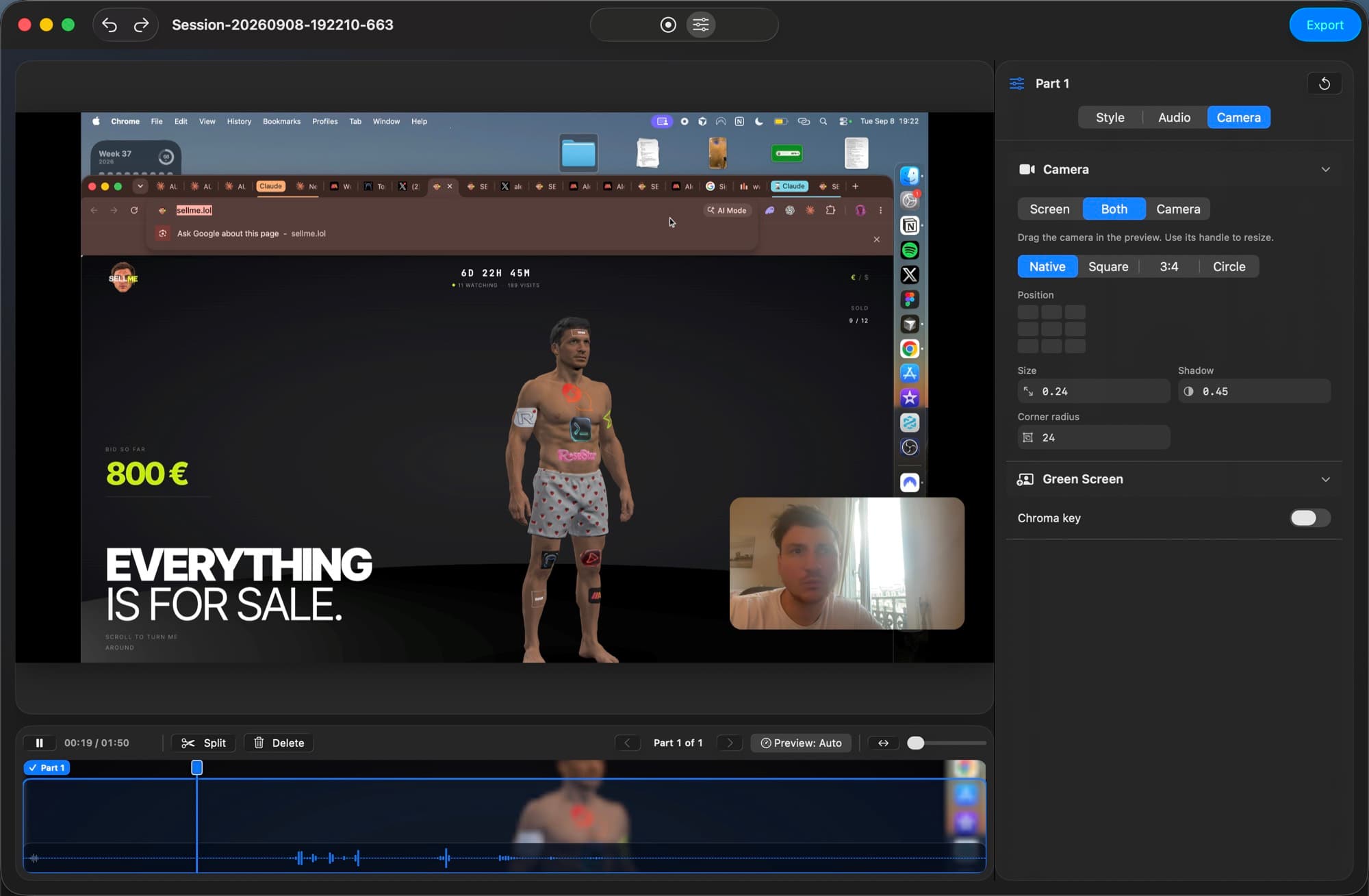
The editor works in parts. Split the timeline, remove a part without destroying it, then give each part its own framing, speed, camera look and background. Values interpolate between parts, so a zoom is a move rather than a jump.
It is a SwiftUI app with no dependencies. No account, no project cloud, no upload step. Sessions land in your Movies folder as ordinary files.
It replaces Screen Studio, and the subscription under it.
Capabilities
What it does
4K60 capture
ScreenCaptureKit into an asset writer, at native pixels, in HEVC, with optional system audio. Full display or a picked window.
Camera and mic
One capture session for both preview and recording. It auto-selects an Osmo Pocket 3 in webcam mode and a Shure mic. A microphone with no camera records audio alone.
Cursor, tracked at 60 Hz
Positions and clicks are stamped on the host clock and rebased onto the first frame of the video, so ripples and auto zooms land where you actually clicked.
Parts, not razor cuts
Split, restore, remove, and per-part framing, speed, mute and camera settings. Removal is non-destructive: the footage is still there.
The look
Auto zoom, motion blur, green-screen removal, padded colour, gradient, wallpaper or image backdrops with blur and grain, and a bordered screen card you can tilt in 3D.
Preview that keeps up
The same compositor drives the live preview and the export, so what you scrub is what you get. Out comes an MP4, or a short GIF.
Where your material goes
One machine, and it is yours
On this Mac
0 crossings
- The screen recording
- The camera track
- The microphone track
- The cursor and click log
- Every edit you make
- The export
The line
Nothing does. No account, no upload, no telemetry.
How it works
The pipeline, as built
Record phase
Straight, and nothing else
screen.mov
4K60 HEVC, native pixels, cursor hidden
camera.mov
or mic.m4a when there is no camera
cursor.json
60 Hz samples, every click stamped
Edit phase
Every cinematic decision, later
parts
split, remove, restore. Nothing is destroyed
look
framing, speed, backdrop, camera, per part
compositor
one Core Image pass drives preview and export
Requirements
What it runs on
| Spec | Detail |
|---|---|
| Requires | macOS 14 or newer. |
| Permissions | Screen Recording is required. Camera and microphone are optional and fall back to screen only. Accessibility enables the global click log. |
| Capture | 4K60 HEVC, native pixels, optional system audio, cursor hidden and redrawn in the edit. |
| Session folder | ~/Movies/RecordLab/Session-*: screen.mov, camera.mov or mic.m4a, cursor.json, session.json. |
| Export | MP4 at full size or 1080p, or a short GIF. |
| Tests | 65 unit tests over the timeline maths, the settings decoding and the session model. |
Honest
Not there yet
- A camera, a microphone and a real export cycle are hardware tests, so they are checked by hand rather than claimed from a synthetic run.
- The Osmo Pocket 3 streams up to 4K30 as a webcam. For its full 4K60 look, record on the Osmo and drop the file into the session folder as camera.mov: the editor picks it up like any other camera track.
Status
Open source, and on the store
RecordLab is being opened up. The repository is private today, so there is nothing to clone yet and no public build to download. When it opens it will be at github.com/AlexSSSaint/RecordLab, under a licence that lets you read it, build it and keep it.
The Mac App Store version is coming after that, so it installs and updates like anything else on your Mac, without a certificate dance. No date, because a date I have not earned is just a way of being wrong later.
Want it the day it ships?
Surface 05 · Left arm · sellme.lol ↗