

GlassTerm
macOS·Apple Silicon·voice first
You talk. The agents type.
Transparent terminal panes over your wallpaper, each one a real login shell running an agent CLI in one of your projects. You never type into a pane. You say what you want, and Molly writes it in.
- Freeno price, no plan
- Open sourcesoon
- Mac App Storesoon
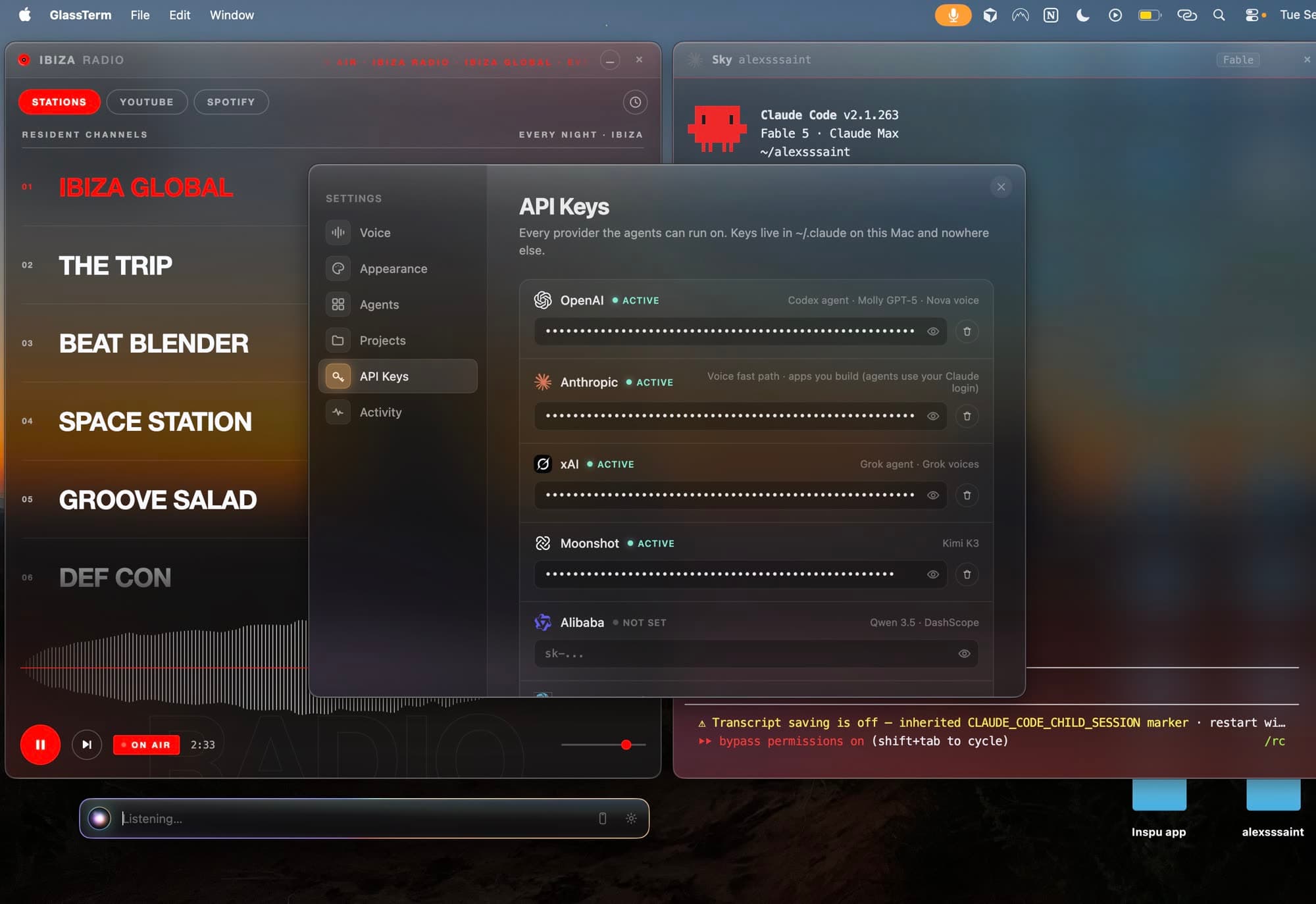
Instead of a screen full of terminal tabs
What GlassTerm is
GlassTerm is a window made of glass panes. Every pane is a real login shell, started in one of your projects, running one of six agent CLIs: claude, codex, grok, kimi, qwen or hermes. Several agents work side by side, on camera, which is what it was built for.
Speech to text runs on this Mac. Holding the fn key streams your voice into a local Parakeet server on MLX, and the text goes to Molly, the single brain. She decides what to do with it, then writes into the pane herself through her send_to_terminal tool.
There is no agent-to-agent bus. Molly is the only hub. Panes share state one way, through a read-only roster and a task board, so nothing an agent says can steer another one behind your back.
It replaces a screen full of terminal tabs, and the hand that has to drive each one.
Capabilities
What it does
Push to talk
Hold the fn key through a compiled Swift key server, or hold the orb in the bar. Click it instead and it stays open, hands free.
Six agent CLIs
claude, codex, grok, kimi, qwen, hermes. Claude panes authenticate through your Claude subscription, never through an API key.
A brain you pick
Molly runs on Claude CLI drivers (fable, opus, sonnet, haiku), OpenAI, xAI, Moonshot, DashScope or Nous. Haiku is the default. Grok Voice is the realtime option, where the model is its own voice.
Ten voices
Five from xAI (Eve, Ara, Rex, Sal, Leo) and five from OpenAI (nova, shimmer, coral, sage, onyx), streamed as PCM. A Swift AVSpeech server and the macOS say command are the gated fallbacks.
Spoken while it is written
Rendering is speculative: sentences are synthesised while the model is still writing the next one, so the reply starts before the answer is finished.
A local fast path
Simple commands are matched by a regex in the intent module and never reach a model at all. No call, no cost, no wait.
Where your material goes
Everything that leaves, named
On this Mac
2 crossings
- Your voice
- Parakeet speech to text (MLX)
- Every pane and every shell
- The task board and the roster
- Molly’s sessions and memory
The line
Off this Mac
The transcribed text
goes to the model you picked in Settings, on your own key
Always
Molly’s reply text
goes to xAI or OpenAI, to be turned into a voice
Only if you switch it on
How it works
The pipeline, as built
What happens when you speak
fn key
held, or the orb in the bar
Parakeet
speech to text, local, on MLX
routeMessage
every utterance goes through here
Fast path
A local regex answers it
No model call, no cost, no wait.
Everything else
Molly decides
One brain, one hub. She calls her tools herself.
send_to_terminal
She types into the pane. You never do.
streamed PCM
She talks back while she is still writing.
Requirements
What it runs on
| Spec | Detail |
|---|---|
| Requires | macOS on Apple Silicon. The speech server runs on MLX. |
| Also needs | Node 18 or newer, and the Xcode command line tools for node-pty. |
| Speech to text | parakeet-tdt-0.6b-v2, started locally when the app is ready. |
| State | ~/Library/Application Support/glassterm: settings, projects, the board, Molly’s memory. |
| Sidecars | ~/.glassterm: the speech server, the key server, the voice server, the roster, the timing log. |
| Keys | One-line files under ~/.claude, entered through Settings. Never sent anywhere but their own provider. |
Honest
Not there yet
- Speech to text is English only.
- Dark mode only.
- No first-run onboarding yet.
- The build is development-signed, so today it runs on my Mac and not on yours. That is the thing the App Store submission has to fix.
Status
Open source, and on the store
GlassTerm is being opened up. The repository is private today, so there is nothing to clone yet and no public build to download. When it opens it will be at github.com/AlexSSSaint/glassterm, under a licence that lets you read it, build it and keep it.
The Mac App Store version is coming after that, so it installs and updates like anything else on your Mac, without a certificate dance. No date, because a date I have not earned is just a way of being wrong later.
Want it the day it ships?
Surface 02 · Abdomen · sellme.lol ↗